Sildenafil side effects: what the trials counted, and why men stop

The short answer
The most common sildenafil side effects are headache, facial flushing, indigestion, a stuffy nose and a brief blue or green tint to vision. In the label's as-needed trials, headache hit 16% of men and flushing 10%, and both rise with dose. Only 2.5% stopped because of side effects, close to placebo. Rare serious events, such as an erection over 4 hours or sudden vision or hearing loss, need urgent care.
In short: most sildenafil side effects are the drug’s blood-vessel effect showing up somewhere other than the penis: a headache, a warm flushed face, indigestion, a stuffy nose. In the placebo-controlled trials summarized on the FDA label for Viagra (the original sildenafil brand), headache affected 16% of men taking it as needed, against 4% on placebo, and only 2.5% of men stopped the drug because of side effects, which was not significantly different from the 2.3% who stopped placebo (Viagra prescribing information, DailyMed). The serious events are rare, real and specific, and they are worth knowing by name. Evidence level: approved drug, labeled use, backed by large placebo-controlled trials and the manufacturer’s post-marketing safety reports.
What are the most common side effects of sildenafil?
The most common sildenafil side effects are headache, flushing, indigestion (dyspepsia), nasal congestion and a temporary change in vision, usually a color tint. The label lists the full set reported by at least 2% of men as headache, flushing, dyspepsia, abnormal vision, nasal congestion, back pain, muscle aches, nausea, dizziness and rash (Viagra prescribing information, DailyMed). The label describes the vision change as transient and peaking near the drug’s peak level in the blood; our guide to how long sildenafil lasts covers how long the drug stays active.
The flexible-dose trials are the closest match to how men actually take it: as needed, at a dose adjusted to response. Here is what those trials counted, set against placebo.
| Side effect (as-needed trials) | Sildenafil (n=734) | Placebo (n=725) |
|---|---|---|
| Headache | 16% | 4% |
| Flushing | 10% | 1% |
| Indigestion (dyspepsia) | 7% | 2% |
| Nasal congestion | 4% | 2% |
| Abnormal vision | 3% | 0% |
| Back pain | 2% | 2% |
| Dizziness | 2% | 1% |
| Rash | 2% | 1% |
Source: Table 2 of the Viagra prescribing information, flexible-dose Phase II/III studies of 2 to 26 weeks. The label describes the vision changes in these studies as mild to moderate and transient, and notes that only one man stopped the drug because of them.
How common is each side effect at 25, 50 and 100 mg?
Side effects become more common as the dose goes up, and the jump is steepest for indigestion and vision changes. In the label’s fixed-dose trials, headache went from 16% at 25 mg to 21% at 50 mg and 28% at 100 mg, while abnormal vision went from 1% to 2% to 11% (Viagra prescribing information, DailyMed).
| Side effect (fixed-dose trials) | 25 mg | 50 mg | 100 mg | Placebo |
|---|---|---|---|---|
| Headache | 16% | 21% | 28% | 7% |
| Flushing | 10% | 19% | 18% | 2% |
| Indigestion | 3% | 9% | 17% | 2% |
| Abnormal vision | 1% | 2% | 11% | 1% |
| Nasal congestion | 4% | 4% | 9% | 2% |
| Back pain | 3% | 4% | 4% | 2% |
| Muscle aches | 2% | 2% | 4% | 1% |
| Dizziness | 3% | 4% | 3% | 2% |
Source: Table 1 of the Viagra prescribing information. This page reports what the trials measured; it does not recommend a dose. Choosing and adjusting one is a clinician’s call, and the label itself lowers the starting point for some men, such as those on certain HIV medicines or alpha-blockers.
Why does sildenafil change your vision?
Sildenafil changes vision because it partly blocks a second enzyme, PDE6, that the retina uses to process light. The label notes the drug is only about 10 times more selective for its target (PDE5) than for PDE6, and says this lower selectivity “is thought to be the basis” for the color-vision effects (Viagra prescribing information, DailyMed). In volunteer testing at 100 and 200 mg, men had a temporary, dose-related difficulty telling blue from green, peaking near the drug’s peak in the blood, with no effect on sharpness of vision or eye pressure.
That is the well-understood version: a tint, more light sensitivity or blur that the label calls transient. It is a different thing from sudden loss of vision, covered next, which is rare and needs urgent care.
What are the rare but serious side effects of sildenafil?
The serious side effects are uncommon but specific: an erection lasting more than 4 hours (priapism), sudden loss of vision in one or both eyes, sudden loss or decrease of hearing, and a dangerous drop in blood pressure when sildenafil is combined with nitrates. The label tells men to stop the drug and seek care for sudden vision loss, which can be a sign of a condition called non-arteritic anterior ischemic optic neuropathy (NAION), and to seek prompt help for sudden hearing loss (Viagra prescribing information, DailyMed).
Putting a size on the NAION risk helps. A case-crossover study led by researchers at Pfizer, the maker of Viagra, found among 43 confirmed cases about a twofold higher risk of NAION within roughly five half-lives of taking a PDE5 inhibitor, and the authors estimated that weekly use adds about three cases per 100,000 men aged 50 and over each year (Campbell et al., J Sex Med 2015). The label adds that most men who developed it already had risk factors such as a “crowded” optic disc, age over 50, diabetes, high blood pressure, heart disease, high cholesterol or smoking.
Heart events need context too. The label records post-marketing reports of heart attacks, bleeding in the brain, mini-strokes and sudden cardiac death in men taking sildenafil, mostly in men with existing cardiovascular risk factors and many during or shortly after sex, and states it is not possible to tell whether the drug, sexual activity or the underlying disease was responsible (Viagra prescribing information, DailyMed). A review of 67 placebo-controlled trials covering more than 14,000 men, plus the manufacturer’s post-marketing database, found no causal link between sildenafil and cardiovascular events (Giuliano et al., Int J Clin Pract 2010). Our broader guide to ED medication side effects covers the same emergencies for the whole drug class.
The non-negotiables
Never combine sildenafil with nitrates (nitroglycerin, isosorbide, or “poppers”): the label states it potentiates their blood-pressure-lowering effect. Get immediate medical help for an erection lasting more than 4 hours, and stop the drug and seek prompt care for sudden loss of vision or hearing.
Does sildenafil cause melanoma or hearing loss?
The evidence on both is observational and points to an association, not a proven cause. On melanoma, a US cohort of 25,848 men found that recent sildenafil use was linked to a higher melanoma risk, and its authors said the finding was “insufficient to alter clinical recommendations” (Li et al., JAMA Intern Med 2014). A larger Swedish study of PDE5 inhibitor users then found a modest increase (odds ratio 1.21), but mostly in men who filled a single prescription, not in heavier users, and mostly in early-stage melanoma, a pattern its authors said “raises questions” about whether the link is causal (Loeb et al., JAMA 2015).
On hearing, a cross-sectional US survey of 11,525 men aged 40 and over found that men reporting hearing impairment were about twice as likely to report sildenafil use, while noting the design gave “only limited insight” (McGwin, Arch Otolaryngol Head Neck Surg 2010). The label lists sudden hearing loss as a post-marketing report in which other medical factors may also have played a role. The honest summary: a real signal worth knowing, not an established effect.
Is sildenafil safe?
Sildenafil has a long, well-documented safety record for most men with ED, but it is not right for everyone, and the exceptions matter. The 67-trial review found it was well tolerated at 50 and 100 mg overall and in men aged 65 and 75 and older (Giuliano et al., Int J Clin Pract 2010). The label rules it out for anyone taking nitrates, and advises caution with alpha-blockers and blood-pressure medicines, with strong CYP3A4 inhibitors such as ritonavir that raise sildenafil levels, and in men with a history of NAION (Viagra prescribing information, DailyMed). Our guide to sildenafil interactions goes through each of those combinations.
The safety question starts before the first pill. Our guide on when to see a doctor about ED covers what a proper check-up looks for.
How does sildenafil work?
Sildenafil works by blocking PDE5, the enzyme that breaks down cGMP, the chemical signal that relaxes the smooth muscle of the penis and lets blood flow in during arousal. The label is explicit that sildenafil “has no effect in the absence of sexual stimulation”: it amplifies a signal the body already sends rather than creating an erection on its own (Viagra prescribing information, DailyMed).
That mechanism explains the side-effect list. PDE5 is also found in blood vessels and other tissues, so the same relaxation produces a flushed face, a headache and a stuffy nose. Our explainer on how ED medications work walks through the biology in more detail.
What is sildenafil used for?
Sildenafil is FDA-approved for two conditions: erectile dysfunction, under the brand Viagra, and pulmonary arterial hypertension (high blood pressure in the lungs), under the brand Revatio (Viagra prescribing information; Revatio prescribing information, both DailyMed). The figures on this page come from the ED trials, which is the use most readers are asking about.
How do sildenafil side effects compare with tadalafil?
Sildenafil and tadalafil share the same core side effects, but the mix differs: sildenafil is more associated with flushing and vision changes, tadalafil with back pain and muscle aches. Comparing the two labels’ as-needed ED trials:
| Side effect | Sildenafil, as needed | Tadalafil 20 mg, as needed |
|---|---|---|
| Headache | 16% | 15% |
| Flushing | 10% | 3% |
| Indigestion | 7% | 10% |
| Back pain | 2% | 6% |
| Muscle aches | not listed | 3% |
| Vision change listed | Yes, 3% | Not in the common-reactions table |
| Stopped for side effects | 2.5% (placebo 2.3%) | 3.1% at 10 or 20 mg (placebo 1.4%) |
Sources: Viagra and Cialis prescribing information, DailyMed. These come from separate trial programs, so read them as a rough guide rather than a head-to-head result. The Cialis label adds that, in its clinical pharmacology studies, tadalafil’s back pain or muscle aches generally started 12 to 24 hours after a dose and typically resolved within 48 hours. For onset, duration and cost side by side, see tadalafil vs sildenafil.
Why do men stop taking sildenafil?
Men who stop a PDE5 inhibitor most often say it did not work well enough or cite psychological reasons, not side effects. In a Portuguese interview study of 327 men with diagnosed ED treated with PDE5 inhibitors, nearly half (48.9%) had stopped treatment; the most common reasons were the drug not working (36.8%), psychological factors such as anxiety, fears or negative beliefs (17.5%), erections recovering on their own (14.4%) and worries about heart safety (8.7%) (Carvalheira et al., J Sex Med 2012). Older men and men whose partners were involved in treatment were less likely to stop.
That fits the label’s trial data, where only 2.5% of men stopped sildenafil because of side effects. For what affects how and when the drug works, see our how long sildenafil lasts guide.
What does sildenafil cost?
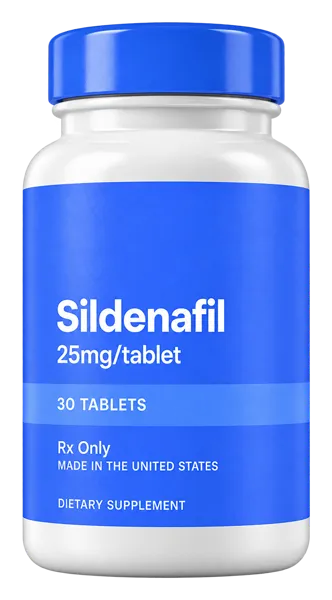
Sildenafil’s cost depends heavily on where it comes from and in what form. The 25 mg oral sildenafil tablet in the “Where it’s sold” card on this page was listed at $120 for a one-month plan when we checked on 2026-10-12, with no three-month plan shown. Insurance coverage and pharmacy prices vary, and our guide to online ED treatment cost explains the main pricing models.
Status: Sildenafil: Active ingredient is FDA-approved; compounded versions are not FDA-approved. What these status terms mean.
Sources
- Viagra (sildenafil citrate) prescribing information, DailyMed
- Cialis (tadalafil) prescribing information, DailyMed
- Revatio (sildenafil citrate) prescribing information, DailyMed
- Giuliano F, et al. Safety of sildenafil citrate: review of 67 double-blind placebo-controlled trials and the postmarketing safety database. Int J Clin Pract. 2010
- Campbell UB, et al. Acute nonarteritic anterior ischemic optic neuropathy and exposure to phosphodiesterase type 5 inhibitors. J Sex Med. 2015
- McGwin G Jr. Phosphodiesterase type 5 inhibitor use and hearing impairment. Arch Otolaryngol Head Neck Surg. 2010
- Li WQ, et al. Sildenafil use and increased risk of incident melanoma in US men: a prospective cohort study. JAMA Intern Med. 2014
- Loeb S, et al. Use of PDE5 inhibitors for erectile dysfunction and risk of malignant melanoma. JAMA. 2015
- Carvalheira AA, et al. Dropout in the treatment of erectile dysfunction with PDE5: a study on predictors and a qualitative analysis of reasons for discontinuation. J Sex Med. 2012
Advertising disclosure: links marked "Paid link" go to Bodybuilding Peptides (trybbpeptides.com), an affiliate destination, and The ED Report may earn a commission if you buy there. Our coverage is independent of that relationship, and nothing on this page is medical or legal advice.
 See it at Bodybuilding Peptides