Is sildenafil the same as Viagra? What the brand name, the generic, and a compounded version actually are

The short answer
Partly. Sildenafil is the active ingredient in Viagra, Pfizer's brand of sildenafil citrate tablets for erectile dysfunction, first marketed in 1998. An FDA-approved generic must match the brand's active ingredient, strength, dosage form, and performance. A compounded sildenafil is not FDA-approved, so it is never accurately called the same as Viagra.
In short: sildenafil is the drug, and Viagra is one brand name for it. Pfizer’s Viagra label describes the tablet as “the citrate salt of sildenafil,” and lists Pfizer’s application NDA020895 with a marketing start date of March 27, 1998 (Viagra prescribing information, DailyMed). Whether a specific pill counts as “the same” depends on which of three categories it falls into: the brand, a generic that passed FDA review, or a compounded preparation. Only the first two have been through FDA review, and only the generic has had to prove it performs like the brand. Here is how to tell them apart, and what sildenafil actually does in the body.
| Product type | Active ingredient | FDA-approved? | Had to show it matches the brand? | What it looks like |
|---|---|---|---|---|
| Viagra (Pfizer brand, for ED) | Sildenafil citrate | Yes, NDA020895 | It is the brand | Blue, rounded diamond, 25, 50, or 100 mg |
| Generic sildenafil tablets (for ED) | Sildenafil citrate | Yes, through an ANDA | Yes, therapeutic equivalence | Varies by maker, e.g. one is a white diamond, 25 to 100 mg |
| Revatio (Pfizer brand, for lung disease) | Sildenafil (as citrate) | Yes, for pulmonary hypertension | Different brand, different use | White, round, 20 mg |
| Compounded sildenafil | Sildenafil, per the pharmacy | No | No FDA review of safety or quality | Whatever the compounding pharmacy makes |
Sources for each row: the Viagra label, a generic sildenafil tablet label marketed under ANDA202255, the Revatio label, and the FDA’s compounding questions and answers.
Is sildenafil the same as Viagra?
Sildenafil is the active ingredient in Viagra, so the medicine doing the work is the same, but “sildenafil” on its own does not tell you which product you are holding. Viagra is Pfizer’s brand of sildenafil citrate tablets for erectile dysfunction (Viagra label, DailyMed). A pharmacy-dispensed generic is a copy that went through FDA review and is held to the brand’s standards, while a compounded version is a separate preparation that the FDA has not approved. The honest one-line answer: same molecule, and only the brand and approved generics carry the FDA’s backing.
What is the brand name of sildenafil?
Sildenafil has two Pfizer brand names in the US, and they treat different conditions. Viagra is the erectile dysfunction brand, sold as 25 mg, 50 mg, and 100 mg tablets (Viagra label, DailyMed). Revatio is the brand for pulmonary arterial hypertension (high blood pressure in the lungs), sold as a 20 mg tablet, an oral suspension, and an injection, and its label says plainly that “sildenafil is also marketed as VIAGRA” (Revatio label, DailyMed).
That shared ingredient is why each label warns against the other. Viagra’s patient information states that it “contains sildenafil, which is the same medicine found in another drug called REVATIO,” and the label tells physicians to inform patients “not to take VIAGRA with other PDE5 inhibitors including REVATIO” (Viagra label, DailyMed). The Revatio label gives the mirror instruction: patients taking Revatio should not take Viagra or other PDE5 inhibitors (Revatio label, DailyMed).
What is sildenafil?
Sildenafil is a prescription phosphodiesterase type 5 (PDE5) inhibitor, a small-molecule drug rather than a peptide. It began as a candidate heart medicine: a review co-written by the Pfizer scientist who, per the paper’s disclosures, was responsible for Viagra’s clinical development for erectile dysfunction describes how it “evolved from a potential anti-angina drug to an on-demand oral treatment for erectile dysfunction (Viagra),” and later to a pulmonary hypertension treatment (Revatio) (Ghofrani, Osterloh and Grimminger, Nature Reviews Drug Discovery, 2006). That history explains why one molecule ended up with two brand names.
What does sildenafil do, and how does it work?
Sildenafil helps the body hold on to the chemical signal that produces an erection, and it does nothing without sexual stimulation. The Viagra label explains the chain: arousal releases nitric oxide in the penis, which raises a messenger called cGMP that relaxes smooth muscle and lets blood flow in; sildenafil blocks PDE5, the enzyme that breaks cGMP down (Viagra label, section 12.1, DailyMed). The same label states that sildenafil “at recommended doses has no effect in the absence of sexual stimulation.”
So it amplifies a response rather than creating one. In Revatio the same enzyme block relaxes blood vessels in the lungs instead (Revatio label, DailyMed). For the wider biology across all the ED pills, see our explainer on how ED medications work, and for timing, how long sildenafil lasts.
What does the research show?
The evidence level here is the strongest this site covers: an approved drug, used for its labeled purpose, backed by large randomized, placebo-controlled trials. The Viagra label summarizes 21 randomized, double-blind, placebo-controlled trials of up to 6 months in more than 3,000 men aged 19 to 87, with sildenafil beating placebo in all 21 (Viagra label, section 14, DailyMed). In four fixed-dose studies covering 1,797 men, 63%, 74%, and 82% of men on 25, 50, and 100 mg reported improved erections, against 24% on placebo (same source).
The best-known published trial, in the New England Journal of Medicine, followed 532 men in a 24-week dose-response study and 329 men in a 12-week dose-escalation study. In the last four weeks of the escalation study, 69% of intercourse attempts succeeded on sildenafil versus 22% on placebo (Goldstein et al., NEJM, 1998). Those numbers describe sildenafil in trial conditions. Approved generics borrow that evidence by proving equivalence; compounded versions have no such link to it.
What is the difference between brand-name Viagra and generic sildenafil?
An FDA-approved generic is a copy of the brand that had to prove it matches, and the FDA describes generics as “FDA-approved copies of brand drugs” with the same active ingredient, strength, dosage form, and route, which “must work the same way in the body” (FDA, Generic Drugs: Questions and Answers). Instead of repeating the original trials, the generic maker demonstrates “that their product is therapeutically equivalent to the brand drug” (same source).
What can differ is mostly cosmetic. The FDA allows “minor differences in appearance between generic and brand drugs, such as in color,” and notes that inactive ingredients can differ between makers (FDA, Generic Drugs Q&A). You can see this on real labels: Viagra is a blue, rounded-diamond tablet whose listed ingredients include FD&C Blue No. 2 and lactose (Viagra label, DailyMed), while one generic sildenafil tablet for ED is a white diamond with a different inactive-ingredient list and no blue dye (generic sildenafil label, ANDA202255, DailyMed). A white pill is not a weaker pill. Our guide to whether generic ED medications are safe covers how to tell an approved generic from a counterfeit. PeptideAgent’s sildenafil vs Viagra explainer also covers why 20 mg sildenafil tablets are labeled for pulmonary hypertension rather than erectile dysfunction.
Is compounded sildenafil the same as Viagra?
No, and it is not accurately called a generic either. The FDA’s compounding guidance draws the line in one sentence: a generic “is approved by FDA under 505(j) of the FD&C Act and meets all of the requirements of that section (including establishing therapeutic equivalence to a brand name drug, among others), while a compounded drug is not approved by FDA” (FDA, Compounding and the FDA: Questions and Answers). Compounded drugs are not FDA-approved, which the agency says “means that FDA does not verify the safety, effectiveness or quality of compounded drugs before they are marketed” (same source).
The active ingredient may be sildenafil, but a compounded preparation has never had to show it matches Viagra in the body, so calling it “the same” or “generic Viagra” claims something no regulator has checked. The FDA also says compounded drugs should only be used for patients whose needs cannot be met by an FDA-approved drug, and warns that poor compounding can produce a drug with “too much or too little active ingredient” (same source). If you are prescribed sildenafil online, it is reasonable to ask the prescriber or pharmacy directly whether you are receiving an FDA-approved generic or a compounded preparation.
Do sildenafil and Viagra have the same side effects?
Approved generics carry the same safety label as the brand, because the warnings belong to the active ingredient. In Viagra’s fixed-dose trials the most common reactions were headache (16% to 28% depending on dose, versus 7% on placebo), flushing (10% to 19%), indigestion (3% to 17%), vision changes such as a color tinge (1% to 11%), and nasal congestion (Viagra label, Table 1, DailyMed). Several rose with dose. In the NEJM dose-escalation study, headache, flushing, and indigestion were likewise the most common effects, in 6% to 18% of men (Goldstein et al., NEJM, 1998).
The serious cautions are the same whatever the label on the bottle says. Sildenafil must not be combined with nitrates, “poppers,” or the lung drug riociguat, and the label advises care with alpha-blockers and certain antibiotics, antifungals, and HIV medicines (Viagra label, DailyMed). Our page on ED medication side effects goes further.
One rule that applies to every sildenafil
Brand, generic, or compounded, sildenafil must never be taken with nitrate heart medicines such as nitroglycerin, with “poppers,” or with riociguat, because the combination can cause a dangerous drop in blood pressure. It should also not be doubled up with Revatio or another PDE5 inhibitor. An erection lasting more than 4 hours needs urgent care.
Sildenafil vs Viagra: myths and facts
| Myth | What the sources say |
|---|---|
| ”Generic sildenafil is a weaker knockoff.” | Approved generics must have the same active ingredient and strength and work the same way in the body (FDA generic Q&A). |
| ”If it isn’t blue, it isn’t real.” | Color and inactive ingredients can differ; the FDA allows minor differences in appearance (FDA generic Q&A; generic ANDA label). |
| ”Revatio is a different drug from Viagra.” | Both contain sildenafil; each label tells patients not to take them together (Viagra and Revatio labels). |
| ”Sildenafil works like an on-switch.” | It has no effect without sexual stimulation at recommended doses (Viagra label, 12.1). |
| ”Any sildenafil is generic Viagra.” | Only FDA-approved generics have shown therapeutic equivalence; compounded drugs are not FDA-approved (FDA compounding Q&A). |
How does sildenafil compare with other ED pills?
Sildenafil is one of several PDE5 inhibitors, and the main practical difference from tadalafil is how long each lasts rather than how it works. Our side-by-side tadalafil vs sildenafil guide sets onset, duration, food effects, and dosing next to each other with sourced figures. The brand-versus-generic question applies to both drugs in the same way.
What does sildenafil cost?
Generics are typically cheaper to bring to market than brands because the generic maker does not repeat the original clinical trials. The FDA explains that generic companies “do not need to repeat the costly clinical trials that establish a drug’s safety and effectiveness,” and instead demonstrate “that their product is therapeutically equivalent to the brand drug” (FDA, Generic Drugs Q&A). Real prices depend on the pharmacy, the strength, insurance, and whether a telehealth consultation fee is bundled in.
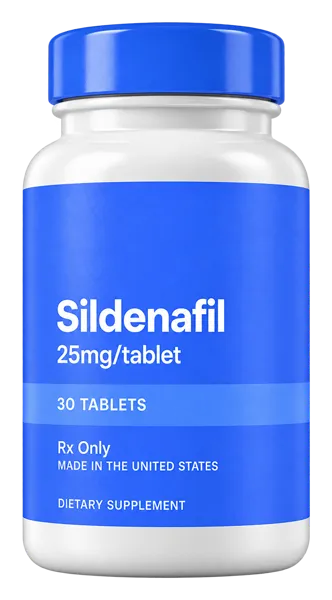
For one reference point, Bodybuilding Peptides listed its sildenafil 25 mg oral tablet at $120 for a one-month plan when we checked its site on 2026-10-12. Our breakdown of what online ED treatment costs explains how consultation fees and pharmacy pricing add up.
What do people get wrong about “same as Viagra”?
The most common slip is treating the ingredient name as a guarantee about the product. “Sildenafil” on a label tells you the molecule, not whether the pill went through FDA approval, which is the part that matters for quality. We do not yet track community posts about sildenafil in our Community Insights data, so this page reports no forum quotes; the questions above are common search questions, answered from the labels and the FDA.
How do you get sildenafil the legitimate way?
Sildenafil is a prescription medicine, so the legitimate route runs through a licensed clinician who checks your heart health and other medicines before prescribing. The Viagra label also says the evaluation of erectile dysfunction “should include a determination of potential underlying causes,” which a pill on its own does not address (Viagra label, DailyMed). Our guide to getting ED treatment online safely walks through what a real online prescription process looks like and the red flags of sites that skip it. A prescription is never promised in advance.
Status: Sildenafil: Active ingredient is FDA-approved; compounded versions are not FDA-approved. What these status terms mean.
Sources
- Viagra (sildenafil citrate) tablets, prescribing information, Pfizer, DailyMed
- Revatio (sildenafil) tablets, oral suspension and injection, prescribing information, Pfizer, DailyMed
- Sildenafil tablets for erectile dysfunction (ANDA202255), prescribing information, DailyMed
- Generic Drugs: Questions and Answers, US Food and Drug Administration
- Compounding and the FDA: Questions and Answers, US Food and Drug Administration
- Goldstein I, et al. Oral sildenafil in the treatment of erectile dysfunction. N Engl J Med. 1998;338(20):1397-1404
- Ghofrani HA, Osterloh IH, Grimminger F. Sildenafil: from angina to erectile dysfunction to pulmonary hypertension and beyond. Nat Rev Drug Discov. 2006;5(8):689-702
Advertising disclosure: links marked "Paid link" go to Bodybuilding Peptides (trybbpeptides.com), an affiliate destination, and The ED Report may earn a commission if you buy there. Our coverage is independent of that relationship, and nothing on this page is medical or legal advice.
 See it at Bodybuilding Peptides